
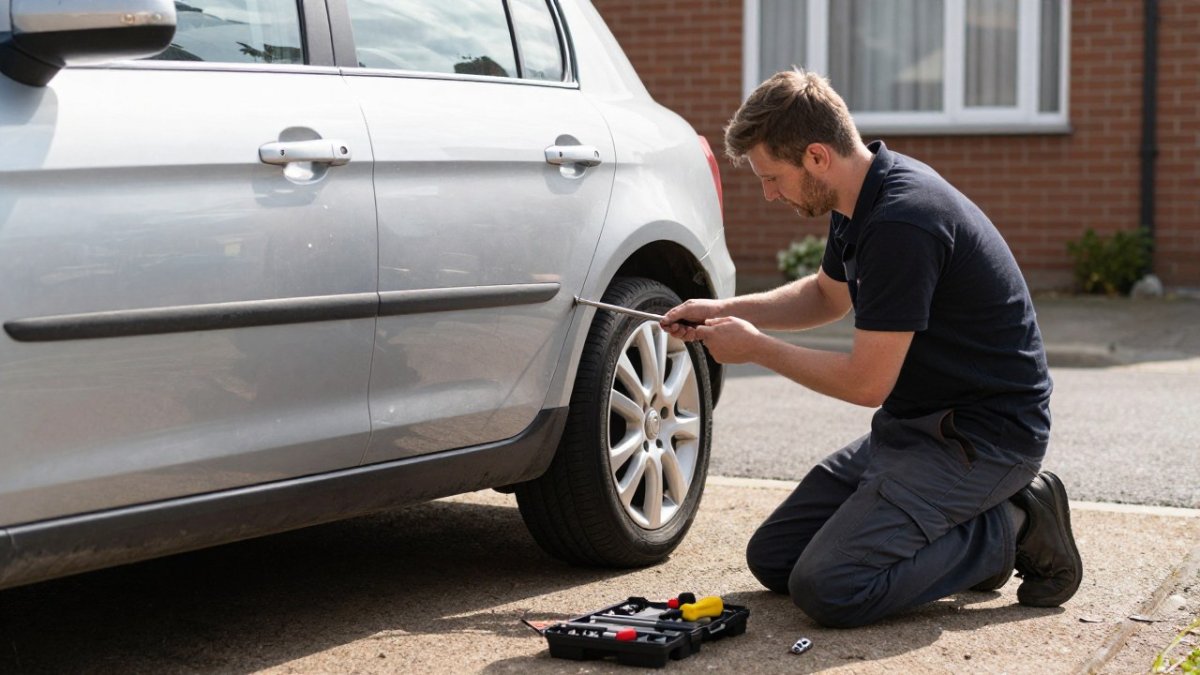
Last Updated: 19 November 2026
Quick Summary
You can fix car dents without a body shop using paintless dent repair, which pushes or pulls the metal back into shape from behind and keeps the original factory paint intact. Small, shallow dents with undamaged paint and rear access can be tackled at home, but creased, cracked or edge dents need a professional.
- PDR works best on round dents with intact paint and no sharp creases.
- Pour hot, not boiling, water over a dent for a minute or two before pushing it out.
- A suction puller and glue kit handle most home jobs; a full pro kit rarely pays off.
- Stop if the dent is larger than your palm or sits on an edge, seam or swage line.
- Mobile repairs usually finish in one to three hours, with a photo quote the same day.
Table of Contents
- What Paintless Dent Repair Is and When It Works on Car Dents
- How to Remove a Small Dent from a Car at Home
- DIY Car Dent Repair Tools Worth Owning
- Car Dent Repair Without Repainting: Protecting the Factory Finish
- When to Stop and Call a Professional
- Mobile Dent Repair: What to Expect from a Call-Out Service
- Insurance, Lease and Resale Considerations
- Get a Free Quote for Your Dent Repair
- Frequently Asked Questions
What Paintless Dent Repair Is and When It Works on Car Dents
Paintless dent repair (PDR) is a method of fixing car dents without body shop involvement, using metal manipulation rather than filler or paint.
PDR works by working the metal, not covering it. The panel is massaged back to its original contour from behind or with special tools.
The result is a repair that keeps your car's value. A repainted panel often raises questions at resale. Original paint does not.
Which Dents Suit PDR and Which Do Not
Not every dent can be fixed this way. Here is the simple test:
- Good candidates: Round dents with no sharp creases, on flat or gently curved panels, with paint that is still intact
- Poor candidates: Dents with cracked or chipped paint, sharp creases, or damage on panel edges and seams
- Needs assessment: Dents on double-skinned panels or areas with no rear access
A common mistake is assuming every small dent is a PDR job. A deep dent with a hard crease has stretched the metal. That metal needs more than pushing.
Watch out: pulling a creased dent with a suction tool can crack the paint, turning a cheap repair into a respray.
How to Remove a Small Dent from a Car at Home
You can fix a small, shallow car dent at home if the paint is undamaged and the panel has rear access. Success depends on the dent type, your patience and the right tools. If the paint is cracked, stop, because home methods will make it worse.
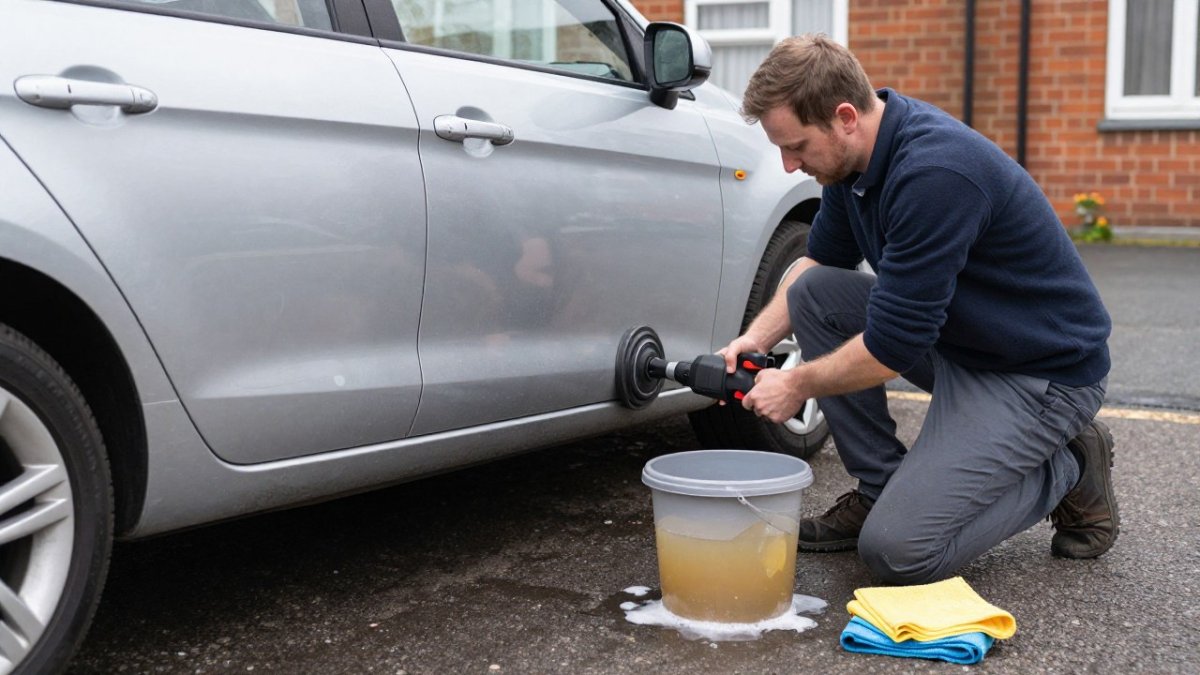
The man is British.
The Hot Water and Plunger Method
- Pour hot, not boiling, water over the dent for a minute or two
- Reach behind the bumper and push the dent out gently
- Or use a clean plunger to pull the dent outward
- Hold the panel until it cools and sets
On metal doors and wings, this method rarely works. Metal is stiffer and the heat does not travel deep enough. For a deeper comparison of methods, read our guide on how to repair a car dent quickly and cost-effectively.
DIY Car Dent Repair Tools Worth Owning
A basic DIY car dent repair tools kit covers small jobs, but only small ones. Here is what is worth the money:
| Tool | Best For | Limitation |
|---|---|---|
| Suction cup puller | Shallow round dents | Struggles on creases |
| Glue tab puller kit | Flat panels, door dings | Can lift paint if rushed |
| Plastic pry tools | Reaching behind trim | Needs panel access |
| Hot water and plunger | Plastic bumpers | Rarely works on metal |
| Dent removal rods | Rear-accessible panels | Needs skill to avoid damage |
Buying a full professional kit rarely pays off for one dent. A suction puller and a glue kit handle most home jobs. Anything with a crease needs a trained eye.
Car Dent Repair Without Repainting: Protecting the Factory Finish
Car dent repair without repainting is the main reason to choose PDR over a bodyshop. Original paint is baked on at the factory and cannot be matched exactly by hand. Keeping it protects both looks and resale value.
A few habits protect that finish:
- Park away from trolley bays and tight corners
- Use a garage or covered spot where possible
- Fit door edge guards on tight driveways
Filler and repainting always leave a trace. A trained buyer or lease inspector can spot a resprayed panel. PDR leaves no such trace when done well.
When to Stop and Call a Professional
Knowing when to stop is the single skill that separates a cheap DIY fix from an expensive bodyshop bill. The signs below are not arbitrary, each one points to a physical limit of home repair. Work through them in order before you touch the panel.
The five-question decision check
Ask yourself these questions in sequence. A single 'no' or 'yes' (as indicated) means stop and seek a professional assessment.
- Is the paint intact? Run a clean fingertip across the dent. If you feel a rough edge, a crack or a chip, the paint barrier is broken. Home pulling will almost certainly lift more paint. Stop.
- Is there a sharp crease? A crease means the metal has stretched beyond its elastic limit. Pushing or pulling a crease without heat and skill typically makes the distortion worse, not better. Stop.
- Can you reach behind the panel? Double-skinned panels, roof rails, sill areas and many modern door internals have no rear access. Without rear access, you are limited to glue-pulling from the front, which is far less controllable. Stop if the dent is more than shallow.
- Is the dent larger than your palm? Larger dents involve more metal movement and a higher risk of oil-canning (where the panel flips between two unstable shapes). That needs a trained hand and proper rods. Stop.
- Does the dent sit on an edge, seam or swage line? These are structural features. Moving metal across a swage line almost always leaves a visible ripple in reflections. Stop.
If you answered 'stop' to any of these, do not attempt a home repair. A professional assessment is quick, and many mobile technicians offer a free photo quote.
Why each sign matters mechanically
- Cracked paint: Once the clearcoat and colour layer are breached, moisture can reach the metal. A home repair that flexes the panel can widen the crack and start corrosion. A bodyshop would need to feather, fill and repaint, which is exactly what PDR is designed to avoid.
- Sharp crease: Metal that has creased has yielded. It will not spring back elastically. Attempting to push it out from behind often creates a reverse crease or stretches the surrounding metal, leaving a wavy reflection that is harder to fix than the original dent.
- No rear access: Glue-pulling from the front pulls the outermost point of the dent first. On a deep dent, that can pull the metal past its original contour, creating a high spot. Rear access lets a technician push the low point precisely.
What a professional assessment actually involves
A competent mobile technician will typically:
- Inspect the dent under a reflection line or a PDR light to judge depth and stretch
- Check paint thickness with a gauge (a cheap DIY gauge is available, but interpretation takes experience)
- Confirm whether rear access is possible by removing trim or using rod access points
A photo assessment is often enough to judge whether a dent is suitable for repair. If a technician says your dent is not a PDR candidate, believe them, forcing it is how small dents become resprays.
Watch out: A common pattern is for DIYers to attempt a creased dent with a suction puller, crack the paint, and then pay more for a respray than the original PDR quote would have cost.
Mobile Dent Repair: What to Expect from a Call-Out Service
Mobile dent repair brings the repair to your driveway or workplace. A technician arrives with the tools and does the job on site, usually within a few hours. No courtesy car. No days without your vehicle.
Here is how our mobile process works, step by step:
- Photo quote: send photos of the dent and we respond the same day
- Booking: pick a time at home or work
- On-site repair: most jobs finish in one to three hours
- Final check: you inspect the repair before we leave
We cover mobile dent repair across Hampshire, including paintless dent removal for door dings and trolley dents. See how our four-step process works before you book.
Insurance, Lease and Resale Considerations
A dent is rarely just a cosmetic problem, it sits at the intersection of insurance excess, lease-return standards and resale value. The right choice depends on which of those three pressures applies to you.
Insurance: when to claim and when to pay
Many minor cosmetic repairs cost less than a typical insurance excess. Claiming also risks losing your no-claims bonus and can raise future premiums, even if the claim is small.
A useful rule of thumb: if the repair quote is below your excess, pay privately.
You are normally required to report any damage to your insurer if a third party is involved or if the damage makes the vehicle unroadworthy.
Lease returns: the fair wear and tear standard
Lease companies in the UK generally assess returned vehicles against the BVRLA Fair Wear and Tear Guide. That guide sets out what counts as acceptable wear and what will be recharged.
The practical point is that end-of-lease charges are usually higher than the cost of fixing the dent yourself before handover.
Watch out: Do not assume a dent that looks small to you will fall below the lease threshold.
Resale: why original paint holds value
At resale, buyers and inspectors look for signs of filler and respray, uneven paint thickness, masking lines, overspray on trim and a mismatch in reflection. A repainted panel raises questions even when the repair is good.
A car with original paint and no dents typically sells faster and for more than one with a resprayed panel, because the buyer has no reason to suspect hidden damage.
The cost comparison that decides it
Indicative UK figures give a sense of the trade-offs:
If you are weighing up a claim, read why you should not claim for a scuff and keep your no-claims bonus intact.
Get a Free Quote for Your Dent Repair
Send us a photo of the dent and we will tell you whether it is suitable for mobile repair. Most repairs cost less than a typical insurance excess, and we respond with a quote the same day.
We come to your home or workplace, complete repairs in one to three hours, and back our bodywork with a lifetime guarantee. Our team of 18 technicians averages 23 years' experience, and we are rated 5.0 by Hampshire drivers on Google.
Fixing car dents without a body shop is realistic for minor damage, but only when you match the method to the dent. Get started with SMART Automotive and contact us for a free quote on your dent repair today.
Frequently Asked Questions
Can I fix a car dent myself without going to a body shop?
You can fix some car dents yourself, but success depends on the damage. Small, shallow dents on flat metal panels with intact paint often respond to suction cups, hot water or push-to-pull tools. Deep dents with creased edges, cracked paint or damage on complex body lines usually need a professional. Assess the paint first: if it is cracked or flaking, DIY pulling risks making it worse, and a mobile dent repair technician can advise on the best route.
Can you fix a car dent without repainting?
Yes, in many cases. Paintless dent repair reshapes the metal from behind the panel or uses glue-pulling on the surface, keeping the original factory finish intact. It works best on dents where the paint has not cracked and the metal has not been stretched beyond its elastic limit. If the paint is broken or the dent has sharp creases, some refinishing may be needed, so ask for an assessment before committing to a no-repaint approach.
How much does professional mobile dent repair cost?
Costs vary with dent size, location and panel access, so get a quote based on your specific damage. As a guide, mobile dent repair is often cheaper than a traditional bodyshop because there is no workshop overhead and the work is done at your home or workplace. Many minor repairs cost less than a typical insurance excess, which makes paying directly an attractive option. Request a free quote with photos of the dent for an accurate figure.
When should I stop trying to fix a car dent myself?
Stop if the paint is cracked, the dent has sharp creases, or the panel sits on a complex curve or body line. Also stop if you have tried a suction cup or hot water method twice without progress: repeated pulling can stretch the metal further and make a professional repair harder. Damage near sensors, cameras or bonded panels is best left to a qualified technician. A free assessment will tell you whether DIY is realistic.
