
Quick Summary
Paintless dent repair is a method that massages dents out from behind the panel without sanding or repainting, so original paint is kept. It suits shallow, accessible dents where the paint is intact and the metal is not overly stretched, but it is not always safe on older, brittle paint.
- Check whether the paint is cracked, flaking or chalky at the dent edge before agreeing any work.
- Confirm the panel material, since GRP and fibreglass cannot be metal-worked and usually rule out PDR.
- Establish whether the back of the dent is reachable through a door cavity, trim panel or inner wing.
- Look for hidden body filler, which does not move with the metal and means the technician should stop.
- Photograph the damage and agree stop conditions in the quote, so an honest early decision can be made.
Table of Contents
- How Paintless Dent Repair Works on a Classic Car
- Classic Car Dent Removal: Checking Whether Your Dent Is a Candidate
- PDR on Original Paint: Preserving the Factory Finish
- Paintless Dent Repair on Repainted Cars: What Changes
- PDR Limitations on Older Paint and When Restoration Is the Better Route
- Paintless Dent Repair Versus Traditional Bodywork: A Comparison
- Booking Your Classic Car Assessment With SMART Automotive
- Frequently Asked Questions
How Paintless Dent Repair Works on a Classic Car
Last Updated: November 26, 2026
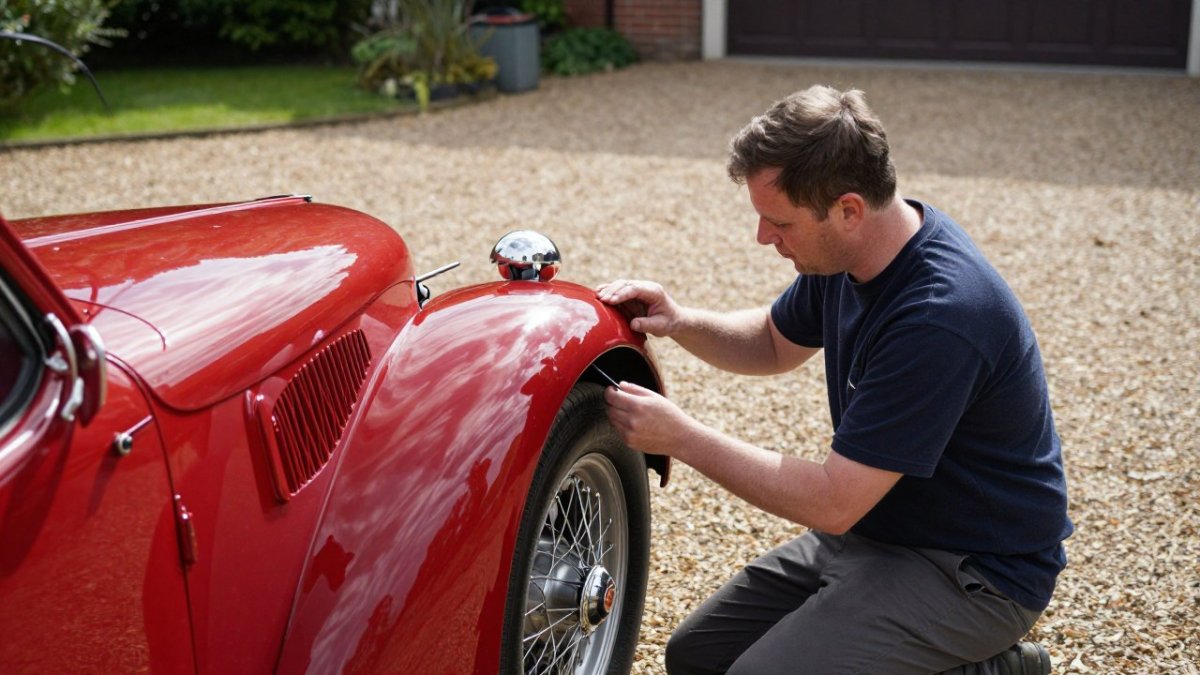
Paintless dent repair, often shortened to PDR, is a method of removing dents by massaging the metal back into shape from behind the panel, without sanding or repainting the surface. For a classic car, original paint is often one of its most valuable features. Whether it suits your car depends on the dent, the paint and the panel, so it is worth understanding how the process works before booking anything.
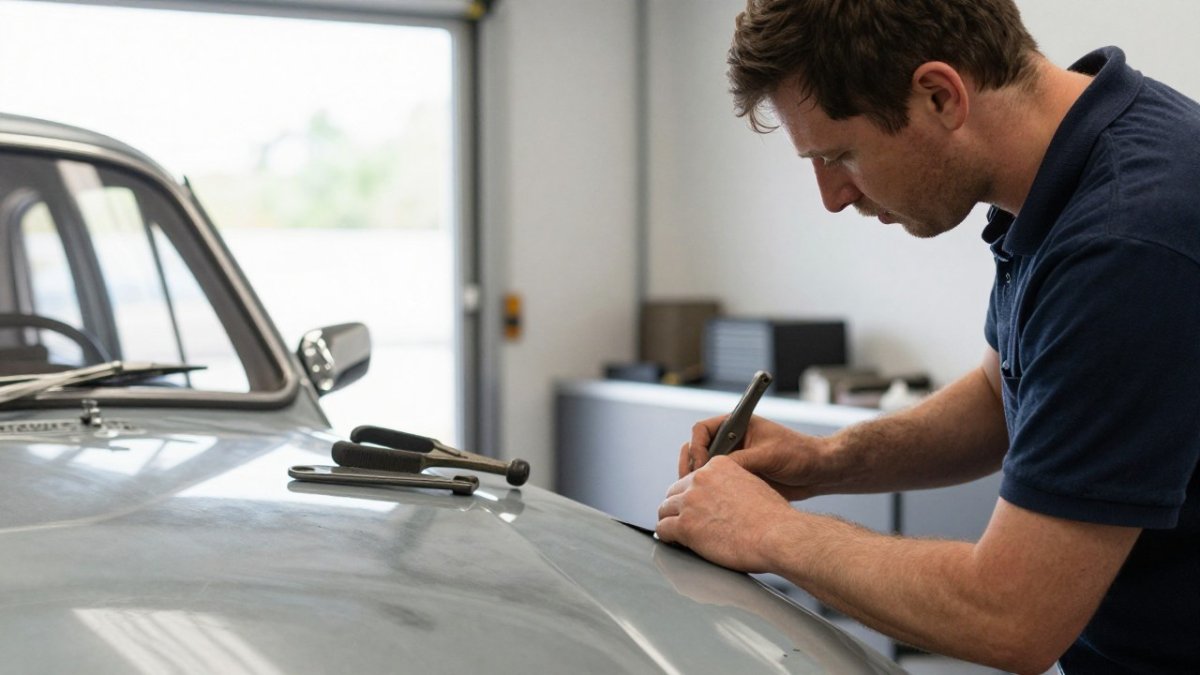
Access is the key question. If the panel can be reached from behind through a door cavity, a removed trim panel or an inner wing, the technician can work the metal from the reverse side using specialist hand tools.
Classic Car Dent Removal: Checking Whether Your Dent Is a Candidate
Classic car dent removal is only suitable when the dent is accessible, the paint is intact and the metal has not been stretched beyond recovery.
Step 1: Identify the panel and its material. Establish whether the dent is in a steel wing, an aluminium bonnet, a GRP or fibreglass panel, or a replacement panel fitted during a previous restoration. Steel and aluminium behave differently: aluminium work-hardens and can crack if moved repeatedly, while GRP cannot be metal-worked at all and usually rules out PDR.
Step 2: Assess the paint film. Look at the dent under a bright, angled light and check for a ring of cracked lacquer, micro-blistering, flaking at the dent edge or a dull, chalky patch that suggests the finish has broken down. Original lacquer and older single-stage finishes can be brittle, and a repaint may be thicker and less flexible.
Step 3: Check access to the reverse of the panel. Confirm whether the back of the dent can be reached through a door cavity, a removed trim panel, an inner wing or a factory access hole. Reinforcements, double-skinned sections, seam sealers and structural bracing all restrict access.
Step 4: Look for previous repair history. Run a small magnet gently over the area and inspect panel gaps, paint edges and overspray. Body filler does not move with the metal, so a technician who finds filler will usually stop rather than risk cracking it away from the panel. Ask the owner or previous repairer for details of past bodywork; this information changes what is realistic.
Step 5: Judge the dent's shape and location. Shallow, gradual dents with soft edges are the best candidates. Sharp creases, dents on body lines, damage close to panel edges, folds and dents over seams are harder because the metal is already stretched or movement is restricted. A dent that has been left to sit may also have taken a set, making it harder to ease back.
Step 6: Agree the outcome before work starts.
A common pattern is that the paint condition and access, rather than dent size alone, decide the outcome on older cars.
PDR on Original Paint: Preserving the Factory Finish
The main advantage of PDR on a classic car is that the original paint stays where it is. Original factory paint is often irreplaceable in terms of colour match, and a repaint can reduce value to some buyers, particularly for well-kept cars.
Many owners find that retaining factory paint is the deciding factor. A repaint, even a perfect one, changes the car's history. PDR keeps the car as it left the factory, provided the paint is in good condition and the dent is suitable.
That said, original paint has limits. Older paint can be brittle, and heating the panel to soften it is not always safe. A competent technician will judge this before starting. If the paint looks fragile, the sensible choice may be to leave the dent alone or choose a different method.
Paintless Dent Repair on Repainted Cars: What Changes
Many classic cars have been repainted at some point, and this changes what PDR can achieve. Repainted panels are not always easy to assess, because the new paint may hide previous damage or filler.
Here is what usually changes:
- Paint thickness: Fresh paint is often thicker than the original, which can make the surface less flexible and more likely to crack when the metal is moved.
- Hidden filler: Previous repairs may have used body filler, which does not move with the metal. A technician who finds filler will usually stop.
- Colour matching: PDR does not require a respray, so a repainted car will keep its existing colour. This is useful if the new paint is already a close match to the rest of the car.
- Repair history: Ask the owner or a previous repairer for details of past bodywork. This information affects what is realistic.
On a repainted car, PDR is still possible, but the assessment must be more careful. A quick look at the surface is not enough.
PDR Limitations on Older Paint and When Restoration Is the Better Route
PDR has clear limits, and recognising them early saves time and money. Restoration, which involves filling, sanding and repainting, is sometimes the better route. The useful question is not whether PDR is possible in theory, but whether the attempt is likely to improve the car without making the damage worse.
Why older paint fails during PDR. Paint is a film with limited flexibility. As a panel flexes during metalwork, the paint on the outer face must stretch with it. Original lacquer and older finishes lose plasticiser over decades and become brittle, so a movement that would be harmless on a modern clearcoat can produce a spider-web crack at the dent edge. Repainted panels add another variable: the new paint may be thicker, and the bond between old and new layers may be weaker than the bond to bare metal.
Why stretched metal cannot always be recovered. When steel or aluminium is dented, the metal stretches. PDR works by easing the metal back, but severely stretched metal has lost some of its shape memory and may need shrinking, which is a different skill and not always possible through limited access. Sharp creases concentrate stress at the fold, and forcing them can tear the metal or crack the paint. Aluminium is particularly prone to work-hardening and cracking if manipulated repeatedly.
Stop conditions to agree before work begins. A responsible technician should stop and reassess, not push on, when any of the following appears:
- Paint cracks, lifts or flakes at the dent edge during the attempt.
- The metal will not move with controlled pressure, suggesting a sharp crease, a double skin or hidden filler.
- Body filler is found under the paint, which will not move with the metal.
- Rust is present at the dent or behind the panel, which PDR cannot repair and which may worsen if the area is disturbed.
- Access is too restricted to work the reverse of the panel safely.
- The panel is GRP, fibreglass or a composite, which cannot be metal-worked.
When restoration is the better route. Choose conventional restoration instead of PDR when the paint is already cracked, flaking or compromised around the dent; when the metal is torn, deeply creased or has sharp folds that cannot be eased; when the dent sits over a seam or structural area where movement is restricted; when previous filler is present and cannot be removed safely; or when rust is present.
Document before you decide. Photograph the damage under angled light, note the panel material and any known repair history, and ask the technician to record their assessment and any stop conditions in the quote. This protects both parties if the attempt has to be abandoned. A common pattern is that the most valuable outcome is an honest 'no' early, before a small dent becomes a paint repair.
Paintless Dent Repair Versus Traditional Bodywork: A Comparison
PDR and traditional bodywork solve different problems. The table below summarises the main differences for a classic car owner.
| Factor | Paintless dent repair | Traditional bodywork |
|---|---|---|
| Original paint | Retained | Usually sanded and repainted |
| Best for | Shallow dents, accessible panels | Deep damage, cracked paint, rust |
| Time | Often a few hours | Often several days |
| Effect on value | Usually preserves originality | Repaint may reduce originality |
| Main risk | Cracking if the metal is forced | Colour mismatch, filler failure |
Pros and cons of PDR on vintage metal and paint:
Pros:
- Keeps original factory paint in place
- Usually quicker and less disruptive than a respray
- Avoids the risk of colour mismatch
- Preserves originality for collectors
Cons:
- Only suitable for certain dents and panels
- Old or brittle paint can crack during the process
- Not possible where filler or rust is present
- Results depend heavily on technician skill
Get a clear quote that states what the repair covers and what would require restoration instead.
Booking Your Classic Car Assessment With SMART Automotive
If you are unsure whether your classic car's dent suits PDR, a proper assessment is the sensible next step. At SMART Automotive, we offer mobile repairs at your home or workplace. We can also look at alloy wheel damage in the same visit.
You can book a dent and door ding repair assessment to get a clear view of your options.
If you have alloy damage as well, our alloy wheel refinishing service covers kerb damage and refurbishment, carried out on your driveway.
To start the process, contact S.M.A.R.T Automotive Hampshire by phone, WhatsApp or email.
Get your classic car assessed before you commit to a repair. SMART Automotive can tell you whether PDR is the right fix or whether restoration makes more sense for your car. Get a free quote today.
Frequently Asked Questions
Does paintless dent repair work on classic cars?
It can, but only where the dent is shallow, the paint is sound and the metal can be reached from behind the panel. Technicians usually check the paint for cracking or thin areas before starting, because original factory finishes on older cars can be brittle. If the paint is likely to crack or the dent sits on a sharp crease, a technician may recommend conventional restoration instead. A written assessment before work starts is the safest way to find out whether your classic car is a suitable candidate.
Can paintless dent repair damage original paint?
Done properly, PDR does not touch the paint surface with fillers or abrasives, which is why it is valued for preserving original finish. The risk comes from applying too much force to brittle paint, which can cause fine cracking or lifting. Ask the technician how they assess paint condition and what they will do if the paint shows signs of stress. A reputable technician will stop if the paint is not suitable rather than push ahead.
Is paintless dent repair better than traditional bodywork for a classic car?
For minor dents on original paint, PDR keeps the factory finish in place where the damage is suitable. Traditional bodywork may be the better option where the metal is badly creased, the paint is already failing, or the panel needs filling and repainting anyway. Compare the expected outcome, the paint condition and the value of originality for your particular car before deciding. SMART Automotive can give you a quote for your vehicle; check the website for current pricing.
Can a classic car be repaired with paintless dent repair if it has been repainted?
Often yes, though the repaint needs checking first. Paint applied over the original finish may behave differently under pressure, and a respray can hide filler or uneven thickness. A technician will look at the panel and paint condition before deciding whether PDR is appropriate. If the repaint has cracked or the panel has been filled, the repair may not be possible without affecting the surrounding paint.
