Table of Contents
- Why Mobile Car Repair for Fleets Beats the Bodyshop Queue
- What Fleet Cosmetic Repairs Actually Cover
- Mobile Bumper Repair for Fleets: Scuffs, Cracks and Colour Matching
- Fleet Scratch and Dent Repair Without Taking Vans Off the Road
- Mobile Alloy Wheel Repair for Fleet Vehicles
- How to Choose a Mobile Car Repair Provider for Your Fleet
- Conclusion
- Frequently Asked Questions
Last Updated: October 11, 2026
Why Mobile Car Repair for Fleets Beats the Bodyshop Queue
Every day a van sits in a bodyshop queue, it earns nothing. That is the simple maths behind mobile car repair for fleets, and it is why more fleet managers are moving cosmetic work away from traditional garages. A kerbed alloy or a scuffed bumper does not need a workshop bay. It needs a technician, a van, and a few hours in your own yard.
At SMART Automotive, we have built our whole service around that idea. We bring the repair to your vehicles rather than the other way round.
The old model is slow by design. You book a slot, drive the vehicle across town, leave it for days, then send someone to collect it. Two journeys, one lost vehicle, and a hire car if you are unlucky.
Mobile repair flips that. The work happens where the vehicle already parks.
The Real Cost of Downtime for a Working Fleet
Downtime is the hidden bill on every cosmetic repair. A vehicle off the road still costs you finance payments, insurance, and depot space. It also costs you the revenue that vehicle would have earned.
Qualified language is honest here: many fleet operators find that the true cost of a repair is far higher than the invoice. The invoice covers labour and parts. The downtime covers everything else.
Then there is presentation. A van covered in scrapes looks neglected to customers and staff alike. Small damage also tends to grow. A cracked bumper left alone can split further. A kerbed wheel can corrode.
"Repaired a nasty kerbed alloy on my driveway in under 2 hours. Looks brand new, saved me a fortune vs the main dealer."
That is the trade-off in one sentence: time saved, money saved, vehicle back in service the same day.
What Fleet Cosmetic Repairs Actually Cover
Fleet cosmetic repairs are the non-structural fixes that keep a vehicle looking sharp without a full bodyshop visit. They cover the damage that builds up from everyday driving: car park scrapes, kerbed wheels, trolley dents, and stone chips.
Most fleet damage falls into a handful of types. Knowing which is which helps you decide what can be fixed on site and what genuinely needs a workshop.
- Bumper scuffs and scratches from low-speed contact
- Cracks in plastic bumper covers that have not reached the reinforcement bar
- Door dents and creases where paint has not broken
- Scratches through the clear coat, including keyed panels
- Kerbed or corroded alloy wheels
- Mirror casing and trim damage
Damage Types That Suit On-Site Repair
On-site repair suits damage that is cosmetic, localised, and does not affect how the vehicle drives. If the panel is deformed, the paint is cracked to bare metal, or a safety system sits behind it, a bodyshop is the right call.
What most guides miss is the middle ground. Plenty of damage sits between "ignore it" and "insurance claim". That is exactly where mobile repair earns its keep.
Mobile Bumper Repair for Fleets: Scuffs, Cracks and Colour Matching
Mobile bumper repair for fleets handles the most common fleet damage of all: the low-speed scuff. A technician repairs the plastic, fills and sands the area, then repaints it to match.
Colour matching is where cheap work shows. Modern vehicles use metallic and pearlescent finishes that change tone under different light. A poor match is obvious the moment the sun hits the panel.
We take colour seriously because it is the first thing anyone notices. Our technicians mix and blend to the factory shade, then blend into the surrounding panel so there is no hard edge.
"Couldn't believe the colour match on my metallic grey door. You genuinely can't see where the scratch was."
Cracks need more care than scuffs. A cracked bumper cover has to be stabilised, plastic-welded where needed, then refinished.
The practical upside for a fleet is simple: no vehicle leaves the site, no courtesy car is needed, and the job is usually done inside a working day.
Fleet Scratch and Dent Repair Without Taking Vans Off the Road
Fleet scratch and dent repair is the part that saves the most disruption. A van that never leaves the depot never needs a replacement, a driver, or a collection run.
The process is straightforward for the fleet manager:
- Send photos of the damage for a quote
- Book a slot that fits your operating hours
- The technician arrives at your site
- Repairs are completed in one to three hours per vehicle
- Vehicles go straight back into service
That last point matters. If you run a delivery round or a rental fleet, a vehicle that returns to service the same morning is worth far more than one that returns next week.
There is also a commercial argument. Most cosmetic repairs cost less than a typical insurance excess. Paying directly keeps your claims record clean and stops small damage from pushing your premiums up.
Mobile Alloy Wheel Repair for Fleet Vehicles
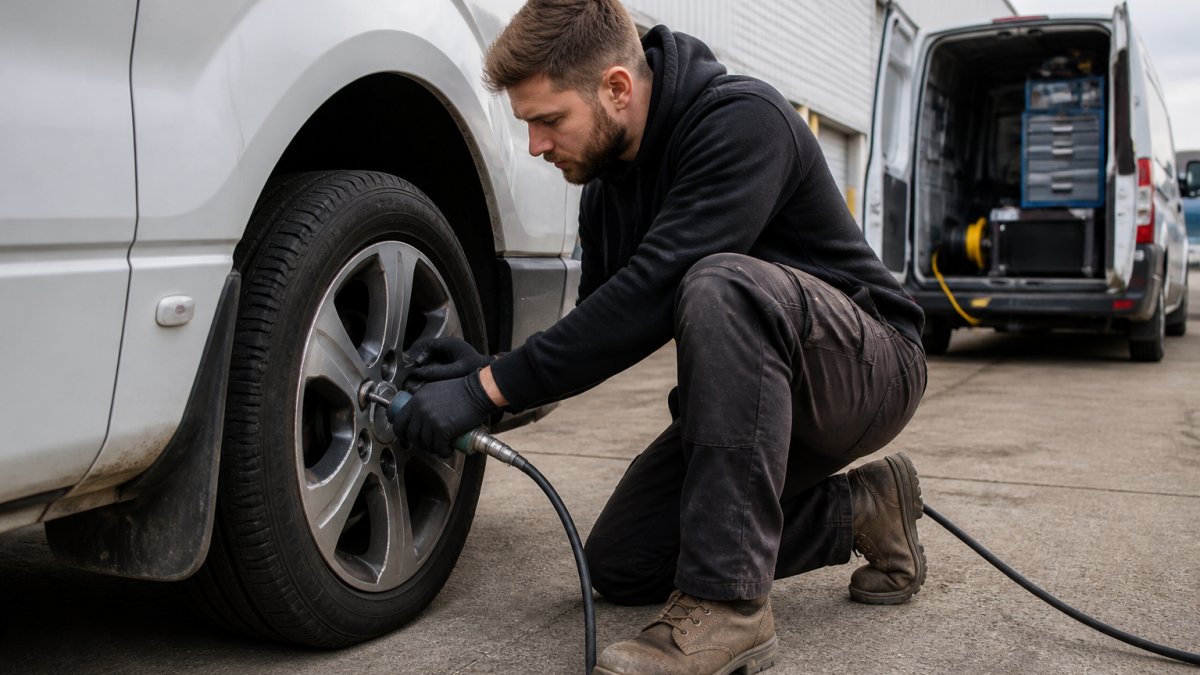
Mobile alloy wheel repair for fleet vehicles fixes kerb damage, scuffs, and light corrosion without removing the wheel or sending it away. Kerbed alloys are almost guaranteed on any working fleet, especially on tight urban routes.
The repair depends on the finish. Standard painted and lacquered wheels are the most straightforward.
We handle specialist finishes rather than pushing you towards a replacement.
A few practical points for fleet managers:
- Kerb damage affects value.
- Corrosion spreads if left.
- Matching a set matters if you plan to sell or return the vehicles
- Repairs can be done on site with the wheel left on the vehicle
"Used them for an end-of-lease tidy up. Saved hundreds in lease return charges. Highly recommended."
How to Choose a Mobile Car Repair Provider for Your Fleet
Choosing a mobile car repair provider comes down to three things: finish quality, reliability, and how well they understand fleet work. A provider who is great with one private car may struggle with twenty vans in a yard.
Ask the awkward questions up front. A good provider will welcome them.
- Colour matching: How do you guarantee a factory-standard match?
- Specialist finishes: Can you handle diamond-cut alloys?
- Guarantee: What happens if a repair fails?
- Insurance and accreditation: Are you properly registered?
- Capacity: Can you handle multiple vehicles in one visit?
- Waste handling: How do you dispose of paint and materials?
- Response time: How quickly do you quote?
SMART Automotive is ISO 9001, 14001 and 27001 registered, and our team of 18 technicians averages 23 years' experience. We are also Environment Agency registered, so waste is handled responsibly.
Evaluation Checklist for Fleet Managers
Use this checklist before you commit to a provider. Score each line honestly.
- Repairs completed on site, at your depot or workplace
- Typical turnaround of one to three hours per vehicle
- Written lifetime guarantee on bodywork
- Demonstrated colour matching on metallic and pearlescent finishes
- Diamond-cut and specialist alloy capability
- Same-day quote response
- Qualified technicians, not subcontracted labour
- Registered waste disposal
- Clear, itemised pricing before work starts
- References from other fleet customers
What to Check | Why It Matters | Red Flag |
|---|---|---|
Colour matching | Finish quality and resale value | Vague answers on paint codes |
Guarantee | Protects you if a repair fails | No written guarantee offered |
Turnaround time | Keeps vehicles earning | "Leave it with us for a week" |
Accreditation | Proof of standards and safety | Cannot name any registration |
Capacity | Handles a whole fleet, not one car | Only works on single vehicles |
If a provider cannot answer these clearly, keep looking.
Conclusion
Cosmetic damage is unavoidable on a working fleet. What you control is how much disruption it causes. Mobile repair keeps your vehicles on site, your drivers on the road, and your costs below a typical insurance excess.
SMART Automotive brings the workshop to you. Our technicians repair bumpers, scratches, dents, and alloys at your home or workplace, usually within one to three hours. Every bodywork repair carries a lifetime guarantee, and we work to a factory-standard finish.
Get a free quote from SMART Automotive and put your fleet back on the road the same day.
Frequently Asked Questions
What does mobile car repair for fleets include?
Mobile car repair for fleets covers cosmetic damage fixed at your depot, office or yard. That means bumper scuffs and cracks, scratches, minor dents, and kerbed alloy wheels. A technician arrives with a mobile unit, works on each vehicle in turn, and most repairs finish in one to three hours. Mechanical faults, major collision damage and structural repairs still need a bodyshop. For fleets, the appeal is that vehicles stay on site and return to service the same day rather than sitting in a queue.
Can mobile technicians repair fleet vehicles at the workplace?
Yes. Mobile providers bring the equipment to your site, so vehicles do not need to be driven to a garage. For a fleet manager, that removes the logistics of booking courtesy cars, arranging driver drop-offs and chasing collection times. You will need a safe, flat working area with enough space around each vehicle, and ideally access to a power supply. Most providers will confirm site requirements when you book, and some can work through a list of vehicles over a single visit.
Is mobile cosmetic repair suitable for leased fleet vehicles?
It usually is, provided the repair meets the leasing company's return standards. End-of-contract charges for scuffs, scratches and kerbed alloys are common, and a professional cosmetic repair can remove that exposure before the vehicle goes back. The key is documentation: keep before-and-after photos and the repair guarantee. Leasing firms assess damage against fair wear and tear guidance, so a repair that restores the panel to a factory-standard finish is normally accepted. Check your specific contract terms first.
How should a business compare mobile repair providers?
Start with coverage area, response times and whether they can handle multiple vehicles in one visit. Ask about colour matching methods, guarantee length, and how they dispose of waste, since environmental compliance matters. Check qualifications such as IMI-trained technicians and ISO registration. Request a sample quote for a typical repair so you can compare like for like, and ask for references from other fleet operators. A provider that offers a written guarantee and clear pricing is easier to manage than one quoting case by case.