
Table of Contents
- Why a Bent Alloy Wheel Is Easy to Miss
- Signs of a Bent Alloy Wheel You Can Feel While Driving
- How to Check an Alloy Wheel for Damage at Home
- Telling a Bent Wheel Apart from Tyre, Balance or Suspension Faults
- Is It Safe to Drive with a Bent Alloy Wheel?
- Bent Alloy Wheel Repair or Replacement: What to Expect
- Booking Your Wheel Inspection with SMART Automotive
- Frequently Asked Questions
Why a Bent Alloy Wheel Is Easy to Miss
Most drivers don't notice a bent alloy wheel until the car starts behaving strangely, and knowing how to tell if an alloy wheel is bent early can save a lot of trouble.
The main reason is that alloy wheels look tough. In reality, a kerb strike or pothole hit can crack or bend the rim, especially on lower-profile tyres that leave less cushion between the wheel and the road. Department for Transport guidance on vehicle safety and tyre condition
Bends are often small. A few millimetres of distortion can be enough to cause problems, but not enough to look obvious from a few steps away. That's why a quick glance is rarely enough. You need to check the wheel from several angles, and ideally with the car on a flat surface.
Here's what makes damage easy to overlook when you're working out how to tell if an alloy wheel is bent:
- Dark or patterned finishes hide shallow dents and scrapes
- Multi-spoke designs make it hard to see the rim edge in full
- Tyres can hide the inner barrel from view
- Gradual wear looks like normal use until the problem gets worse
Signs of a Bent Alloy Wheel You Can Feel While Driving
Your car often tells you about wheel damage before you see it. The signs tend to show up as changes in how the car feels on the road. Pay attention to vibration, steering behaviour and any sudden drop in tyre pressure.
Vibration at motorway speeds
A bent wheel often causes a vibration that appears at a particular speed. Many drivers notice it between about 50 and 70 mph, often felt through the steering wheel. The vibration can also come through the seat or the floor, which can make it hard to pinpoint.
A bent wheel is only one possible cause. Tyre balance problems and worn suspension parts can cause similar shaking, so note when the vibration starts and whether it changes with speed.
Steering pull and changes in handling
If the car pulls to one side, or the steering feels slightly off-centre on a straight road, the wheel may be out of true. You might also notice that steering responds differently, feeling vague or slow to return to centre.
Watch out: handling changes can also come from wheel alignment or suspension faults. Don't assume the wheel is the only cause without checking.
How to Check an Alloy Wheel for Damage at Home
A basic inspection takes about 10 to 15 minutes and needs only a torch, a clean flat space and, for the deeper checks, a jack and axle stands. If you've spotted a scuff, scratch, dent or kerbed alloy, you can upload photos of your damage for an instant guide to the likely repair. Work in two stages: what you can check with the wheel fitted, then what needs the vehicle lifted. Only do this with the engine off, the handbrake on and the transmission in park or first gear.
With the wheel fitted
- Park on level ground. Choose a flat driveway or car park and chock the wheels you are not inspecting so the car cannot roll.
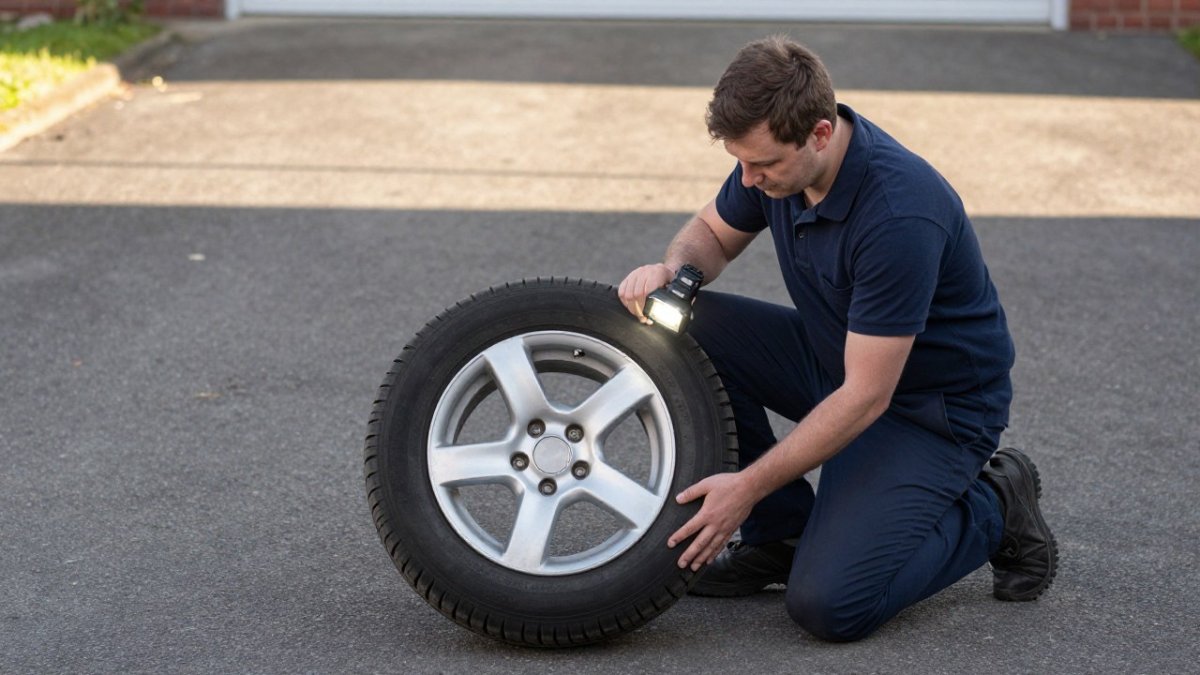
- Check the outer rim lip. Crouch beside each wheel and run a torch along the outer edge. Look for flat spots, dents, kerb rash and hairline cracks where the rim meets the tyre bead.
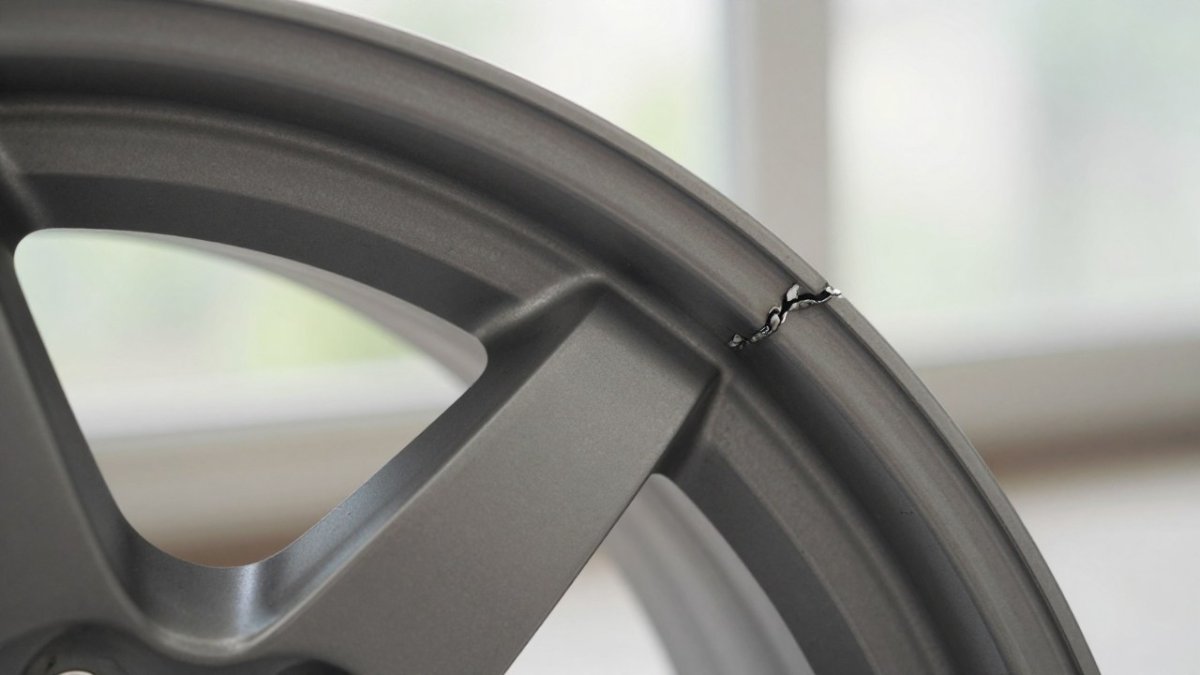
- Check the spokes and hub face. Look for cracks where the spokes meet the rim and around the bolt holes. A crack here is a replacement, not a repair.
- Look through the spokes at the inner barrel. Shine the torch through the gaps and check the inside of the rim for dents or distortion. Inner-barrel damage is easy to miss because most visual checks stop at the outer face, yet a bend on the inside can still cause vibration and air loss.
- Check tyre pressure and bead seating. A slow leak that returns after inflation can point to a damaged bead seat on the rim. Compare pressures across all four tyres.
With the vehicle lifted
- Lift the car safely. Use a trolley jack on the manufacturer's jacking points and support the car on axle stands before you put any part of your body under it. Never rely on the jack alone.
- Spin the wheel by hand. Turn the wheel slowly and watch the rim edge against a fixed reference, such as a straightened piece of wire held close to the lip. A wheel that is out of true will show a visible wobble or a gap that opens and closes as it turns.
- Check for play. Grip the tyre at the top and bottom and rock it. Movement can indicate a worn wheel bearing or suspension joint rather than a bent rim, so note what you feel before assuming the wheel is at fault.
Watch out: a wheel that wobbles when spun by hand may be bent, but it may also be badly balanced or have a distorted tyre, do not book a straightening job on the strength of a hand-spin alone.
Measuring runout
A workshop can measure runout with a dial gauge held against the rim: radial runout is how far the rim moves in and out from centre, and lateral runout is how far it moves side to side. Acceptable limits are set by the wheel and vehicle manufacturer, so ask the technician to confirm the limit for your wheel and show you the reading.
The table below sets out the main steps of a basic inspection, so you can work through them in order.
| Step | What to do | Time or frequency |
|---|---|---|
| Park on level ground | Chock the wheels you are not inspecting | Before starting |
| Check the outer rim lip | Run a torch along the edge for flat spots and cracks | With wheel fitted |
| Check spokes and hub face | Look for cracks near spokes and bolt holes | With wheel fitted |
| Look through spokes | Check the inner barrel for dents or distortion | With wheel fitted |
| Check tyre pressure | Compare all four tyres for a slow leak | With wheel fitted |
| Lift the car safely | Use axle stands, never the jack alone | Vehicle lifted |
| Spin the wheel by hand | Watch the rim against a fixed reference for wobble | Vehicle lifted |
| Check for play | Rock the tyre top and bottom | Vehicle lifted |
Telling a Bent Wheel Apart from Tyre, Balance or Suspension Faults
Several faults feel almost identical from the driver's seat. A bent wheel, an unbalanced tyre, a worn suspension joint and a distorted tyre can all cause vibration or pull, so use the pattern of the symptom rather than a single clue to narrow the cause.
A symptom-to-cause guide
- Vibration that appears at one speed band and fades above it: most often wheel balance or a bent wheel. Balance problems usually show up in a narrow band, often around 50 to 70 mph, and may come and go with load.
- Vibration that is present at most speeds and worsens with speed: more consistent with a bent wheel, a distorted tyre or a worn bearing.
- Vibration felt mainly through the steering wheel: points towards the front wheels or front suspension.
- Vibration felt through the seat and floor: points towards the rear wheels, rear tyres or rear suspension.
- Pull to one side on a straight road: can come from wheel alignment, a binding brake, a mismatched tyre or a bent wheel. Alignment alone rarely causes vibration.
- Clunks, bangs or a bouncy ride over bumps: suspension or bush wear rather than a bent rim.
- Uneven or scalloped tyre wear: often suspension geometry or worn dampers, though a bent wheel can also cause irregular wear.
- Slow pressure loss that returns after inflation: damaged bead seat, a cracked rim, a faulty valve or a puncture. Swap the wheel to the spare if you have one and see whether the leak follows the wheel.
A practical test sequence
- Note the speed band where the vibration starts and stops, and whether it changes with passengers or load.
- Check tyre pressures and look for uneven wear across all four tyres.
- Inspect each rim for visible damage, including the inner barrel.
- If the wheel is suspect, ask a technician to measure runout before replacing parts.
- Only then move on to balancing, alignment and suspension checks.
Start with the simple inspection, then ask a technician to measure the wheel's runout, which shows how far the rim moves from true.
DVSA guidance on tyre and wheel condition for MOT testing
Is It Safe to Drive with a Bent Alloy Wheel?
Driving on a bent alloy wheel is risky, and the risk grows with time. A badly bent rim can lose its grip on the tyre bead, causing a sudden loss of air. That can lead to a serious loss of control, especially at speed.
Driving on a slightly bent wheel for a short trip to a garage is usually less risky than a long motorway journey. Drive slowly, avoid potholes and kerbs, and book an inspection as soon as possible.
Stop driving and get help if you notice any of these:
- Rapid loss of tyre pressure
- Vibration that gets worse with speed
- Visible cracks in the rim or spokes
- A tyre that won't hold air after inflation
Bent Alloy Wheel Repair or Replacement: What to Expect
Many bent alloy wheels can be repaired. A specialist can straighten a mild bend, then check the wheel's runout to confirm it's within safe limits. Heavier damage, cracks or deep distortion usually mean replacement.
Repair works well for minor kerb damage, especially when the wheel is otherwise sound. Replacement is the safer choice if the rim is cracked, the metal is weakened, or the wheel can't be brought back within tolerance. Ask the technician to explain the measurements, so you understand the decision.
At SMART Automotive, our mobile service can refinish alloy wheels at your home or workplace. Repairs are completed in 1 to 3 hours. Pricing depends on the damage, so please request a free quote for your specific wheel.
Booking Your Wheel Inspection with SMART Automotive
If you're unsure whether your wheel is bent, a professional check gives you a clear answer. At SMART Automotive, our team of 18 technicians, with an average of 23 years' experience, can inspect your wheels at your home or workplace. We respond to quote requests on the same day, and our work comes with a lifetime bodywork guarantee.
Ready to find out what's going on with your wheel? Get a free quote from SMART Automotive and we'll tell you what to do next.
Last Updated: 24 November 2026
Frequently Asked Questions
What are the signs of a bent alloy wheel?
The most common signs are a vibration through the steering wheel or seat that appears at particular speeds, usually around motorway pace, a steering pull or change in how the car tracks, and a slow loss of tyre pressure that keeps returning. Visible signs include a rim that looks out of round, flat spots on the lip, or a kerb mark that has bent the edge inward. Any one of these is reason to inspect the wheel before driving further.
Can you feel a bent wheel while driving?
Yes. A bent alloy wheel often causes a vibration that you feel in the steering wheel, the seat or the floor, and it tends to get worse with speed. Drivers frequently notice it first on the motorway. Because tyre imbalance and suspension wear can cause similar symptoms, the feeling alone does not confirm the wheel is bent, so a visual and runout check is the next step.
Can a bent alloy wheel be repaired?
Often, yes. Minor bends on an alloy wheel can sometimes be straightened by a specialist, and the wheel is then checked for runout and for cracks before it is refitted. Cracked or heavily deformed wheels usually need replacing, because a repair cannot restore the structural strength of the metal. A professional inspection is the only reliable way to decide between repair and replacement, so book one before deciding.
Is it safe to drive with a bent alloy wheel?
It is not advisable. A bent wheel can cause vibration that reduces control, can allow the tyre bead to lose its seal and lose air, and in serious cases can crack or fail under load. If you notice a bent wheel, reduce speed, avoid motorways where possible and arrange an inspection promptly. If the tyre is losing pressure or the wheel is visibly cracked, do not drive the car at all.
