Last Updated: October 23, 2026
Quick Summary
Yes, professional mobile car repairs match factory paint with remarkable accuracy when done properly. Mobile technicians use paint codes, spectrophotometers, and computerised mixing systems to achieve factory-standard finishes, with success depending on proper equipment, blending techniques, and surface preparation.
- Paint codes eliminate guesswork by providing the precise pigment ratio and clear coat specification your manufacturer used.
- Spectrophotometers measure colour values at multiple angles, essential for matching metallic and pearl finishes accurately.
- Blending extends repairs into adjacent panels, feathering edges so colour transitions are invisible to the eye.
- Most mobile bumper repairs take 2-3 hours on site using plastic-specific primers and flexible paints.
- Quality checks include visual inspection from multiple angles, close examination under bright light, and testing across different lighting conditions.
Table of Contents
- Can Mobile Car Repairs Match Factory Paint?
- How Car Paint Code Matching Works
- Metallic Car Paint Matching: Extra Challenges
- Paint Blending Car Repair Techniques
- Mobile Bumper Scuff Repair and Paint Matching
- Tools and Equipment Technicians Use On Site
- Common Challenges and How Technicians Solve Them
- Quality Checks: How to Verify a Paint Match
- Frequently Asked Questions
Can Mobile Car Repairs Match Factory Paint?
The short answer is yes, professional mobile car repairs match factory paint with remarkable accuracy. But the process is far more technical than most car owners realise, and success depends on several critical factors working in concert.
At SMART Automotive, we've learned that mobile repairs aren't a compromise on quality. When done properly, they deliver factory-standard finishes that hold up under close inspection. The key is understanding how paint codes work, what equipment technicians need on site, and how blending techniques bridge the gap between old and new paint.
This guide explains exactly how mobile technicians achieve those results, and what can go wrong when they don't.
How Car Paint Code Matching Works
Your vehicle's paint code is the foundation of any accurate colour match. It's a unique identifier that tells a technician precisely which pigments and clear coat your manufacturer used.
Finding your vehicle's paint code
Every car has a paint code printed somewhere on the vehicle. The location varies by manufacturer, but common spots include the inside of the driver's door, the door jamb, or under the bonnet near the engine bay. The code is usually a combination of letters and numbers, something like "PB9" or "LY7M" depending on your car's make and model.
You can also find it in your vehicle's handbook or contact your main dealer with your registration number. SMART Automotive technicians locate the code within minutes of arriving at your location. Once they have it, they can order or mix the exact paint specification your factory used.
Why paint codes matter for accuracy
Paint codes eliminate guesswork. Without one, technicians are working from memory or visual estimation, a recipe for mismatched colour. With the code, they know the precise ratio of pigments, the type of clear coat, and any special finishes like metallic or pearl effects.
The code also tells technicians whether your paint is single-stage (colour and protection combined) or two-stage (colour plus separate clear coat). This distinction matters enormously. Applying the wrong type of paint system over existing paint creates adhesion problems and premature failure.
Metallic Car Paint Matching: Extra Challenges
Metallic and pearl finishes add a layer of complexity that solid colours don't have. The colour shifts depending on viewing angle and light conditions, what looks perfect in daylight might look slightly off under sodium streetlights.
Metallic paint contains suspended metal flakes that scatter light. The concentration and size of those flakes determine how much the colour shifts as you move around the car. Matching this requires not just the right pigment mix, but the right particle distribution.
Professional technicians use spectrophotometers, handheld devices that measure colour values at multiple angles. This tool reads the original paint's exact light-reflecting properties and tells the mixing system how to replicate them. Without this equipment, metallic matching is essentially guesswork.
The real challenge emerges when you're repairing a small section. New metallic paint sits beside paint that's been exposed to UV light and weathering for years. The aged paint has faded slightly; the new paint is vibrant. Technicians solve this through blending, extending the repair area beyond the visible damage so the transition is gradual rather than a hard line.
Paint Blending Car Repair Techniques
Paint blending is where mobile repairs prove their worth. Instead of painting only the damaged panel, technicians extend the repair into adjacent panels, feathering the edges so the transition is invisible.
Here's how it works in practice:
- Identify the transition zone. The technician determines where old paint meets new, usually on an adjacent panel or into a door jamb where the colour shift is less noticeable.
- Prepare the blend area. Light sanding and cleaning ensure the new paint adheres properly and the surface is uniform.
- Apply paint in stages. Rather than one thick coat, technicians apply multiple thin coats, gradually reducing the coverage as they move away from the repair.
- Use clear coat strategically. A protective clear coat goes over the repair, then extends into the blend zone to create a seamless protective layer.
The skill here is knowing how far to blend. Blend too little and you see a hard edge. Blend too much and you're repainting half the car. Professional technicians develop this judgment through thousands of repairs, they know instinctively how far the eye can detect a colour shift.
Mobile technicians can see your car in its actual environment, under your driveway lighting, in your garage, in daylight. They're not working under artificial shop lights that can mask colour mismatches.
Mobile Bumper Scuff Repair and Paint Matching
Bumper scuffs are among the most common repairs mobile technicians handle. Bumpers are plastic, not metal, which changes the repair process slightly.
Plastic bumpers need specific primers and paints designed for flexibility. Regular automotive paint cracks on plastic because plastic flexes slightly when the car moves or the temperature changes. The paint needs to flex with it.
The colour-matching process is identical: find the code, mix the paint, apply in stages with blending. But the substrate preparation is different. Technicians must use plastic-specific primers and ensure the paint system is compatible with the bumper material.
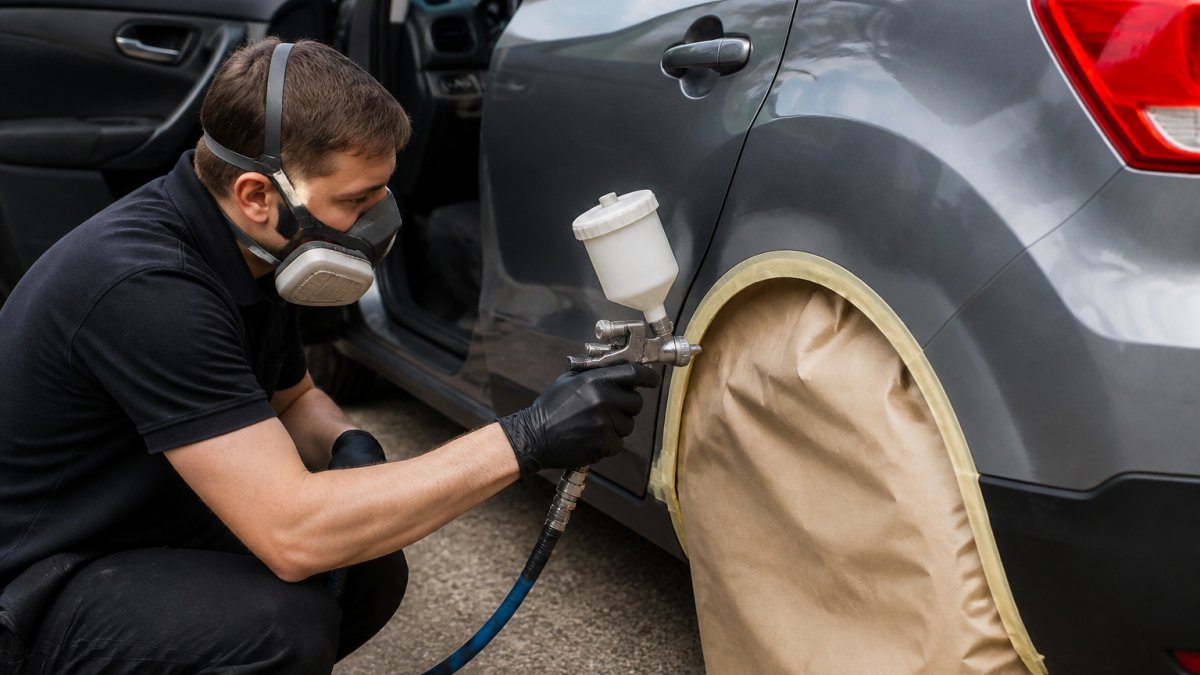
Mobile bumper scuff repair works particularly well because bumpers are easy to access on site. Technicians don't need to remove the bumper or work in a spray booth. They can mask off the surrounding areas, prep the scuff, apply primer, paint, and clear coat, all while your car sits in your driveway.
The result is a repair that is cheaper, quicker, and cleaner than a traditional bodyshop. Most bumper repairs take 2-3 hours on site.
Tools and Equipment Technicians Use On Site
Professional mobile technicians arrive with a mobile workshop. The equipment they carry determines whether they can achieve factory-standard results or settle for something mediocre.
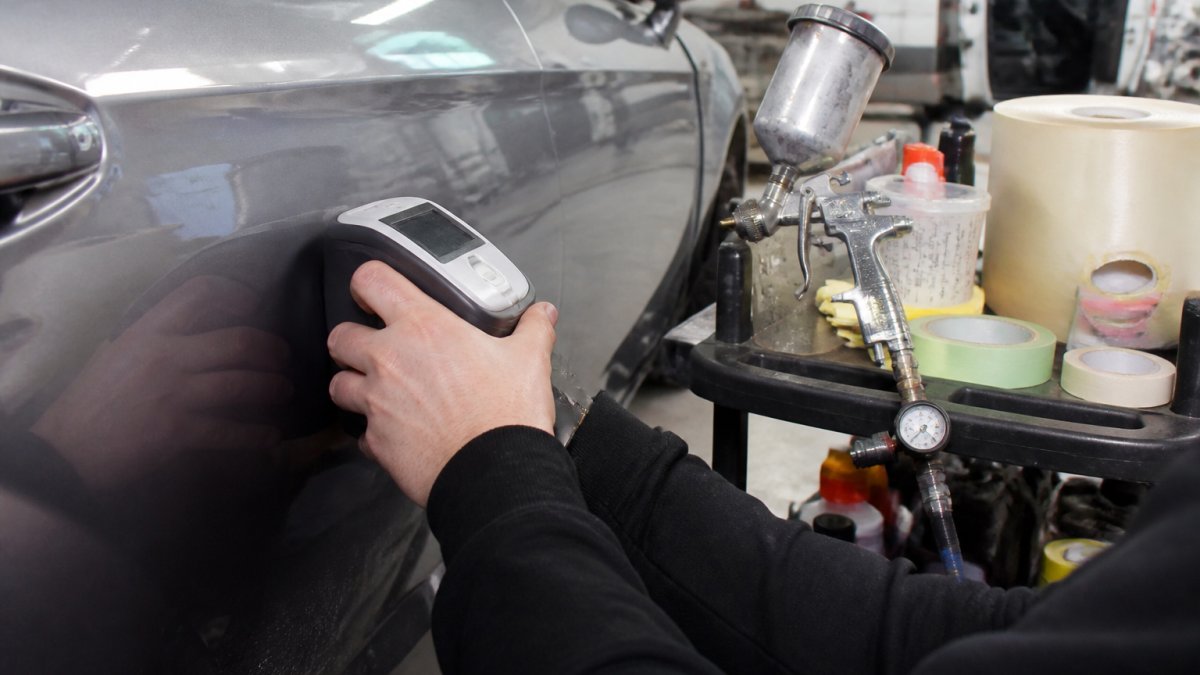
Essential on-site equipment includes:
- Spectrophotometer. This handheld device measures colour values and light-reflecting properties. It tells the mixing system exactly how to replicate the original paint. Without one, you're relying on visual estimation.
- Paint mixing system. Modern mobile units include computerised mixing machines that measure pigments to within fractions of a gram. Precision here is what separates professional results from amateur ones.
- Spray equipment. HVLP (high-volume, low-pressure) sprayers deliver paint evenly without excessive overspray. Portable compressors provide consistent air pressure, critical for proper paint atomisation.
- Masking materials. Tape, paper, and plastic sheeting protect surrounding areas. Quality masking prevents paint drift and keeps the repair zone clean.
- Sanding and prep tools. Orbital sanders, sanding blocks, and tack cloths prepare surfaces. Proper prep is non-negotiable, paint won't adhere properly to dirty or poorly prepared surfaces.
- Clear coat and primers. Professional technicians carry multiple primer types (plastic primers, metal primers, epoxy primers) and clear coats matched to the vehicle's original specification.
- Lighting equipment. Portable LED work lights ensure technicians can see colour accurately during application and inspection.
The investment in this equipment separates professionals from cowboys. A technician with a spectrophotometer and proper mixing system can match your factory paint.
Common Challenges and How Technicians Solve Them
Paint matching sounds straightforward until you encounter real-world complications. Here's what actually happens on site, and how professionals navigate it.
Challenge: The paint code is missing or unreadable.
Solution: Technicians use spectrophotometers to read the existing paint directly. By measuring colour values across multiple angles, they can determine the exact pigment mix. It's slower than using a code, but it works.
Challenge: The original paint has faded significantly.
Solution: This is where blending becomes essential. New paint looks vibrant next to faded paint, creating a visible mismatch. Technicians extend the repair area and feather the edges, so the transition happens gradually.
Challenge: Environmental conditions are poor (cold, damp, windy).
Solution: Paint needs specific temperature and humidity ranges to cure properly. If conditions are unfavourable, technicians may delay application or use fast-drying primers and paints formulated for cooler weather.
Challenge: The repair area is on a curved or textured surface.
Solution: Curved surfaces make colour matching harder because light reflects differently across the curve. Technicians adjust their spray angle and distance to account for this.
Challenge: Multiple colours meet at the repair site (e.g., a two-tone vehicle).
Solution: Technicians identify the colour boundary and position the repair to avoid it when possible. If the boundary is unavoidable, they plan the blend zone carefully so the transition between colours is natural.
Quality Checks: How to Verify a Paint Match
A professional repair should pass several quality checks. Here's what to look for when the technician finishes.
Visual inspection in natural light. Step back and view the repair from multiple angles and distances. Walk around the car, the colour should match from all directions.
Close inspection under bright light. Get close to the repair and examine it under a work light or torch. You should not see a hard edge or colour boundary.
Feel the surface. Run your hand over the repair. It should feel smooth and level with the surrounding paint. Any bumps, runs, or orange-peel texture indicate poor spray technique or contamination.
Check the clear coat. The clear coat should be glossy and uniform. Dull spots or streaks suggest uneven application.
Inspect in different lighting. View the repair under daylight, streetlights, and indoor lighting. Colour should remain consistent across different light sources. Metallic finishes should maintain their colour shift.
If the repair passes these checks, the technician has done their job properly. A quality mobile repair should be indistinguishable from factory paint.
Paint matching isn't magic, it's precision. When mobile technicians arrive with the right equipment, the right knowledge, and the right technique, they deliver results that rival traditional bodyshops.
SMART Automotive technicians use spectrophotometers and computerised mixing systems to match your factory paint with factory accuracy. We complete most repairs in 1-3 hours, and our work carries a lifetime bodywork guarantee.
Frequently Asked Questions
Can mobile car repairs truly match factory paint, or will the repair be noticeable?
Yes, mobile car repairs can match factory paint when technicians use proper paint code matching and blending techniques. The quality depends on the technician's experience and the equipment used. Professional mobile repair services use spectrophotometers to analyse your vehicle's original paint and apply matched paint with precision blending to ensure the repair blends seamlessly with surrounding panels. Most repairs become virtually undetectable once complete, though extreme angles and direct sunlight may reveal very slight variations on metallic finishes.
How do technicians match metallic car paint on a mobile repair?
Metallic paint matching is more complex than solid colours because it contains reflective particles that shift appearance depending on light angle. Technicians use advanced spectrophotometers to measure the metallic content, pearl depth, and colour saturation. They then spray multiple thin layers with proper blending onto adjacent panels to ensure the metallic particles align correctly. This requires skill and experience, metallic finishes demand more precision than standard colours, which is why specialist mobile repair services invest in high-quality equipment.
What's the difference between paint blending car repair and a standard repaint?
Paint blending car repair involves feathering the new paint across the damaged panel and onto adjoining panels to create a seamless transition. Rather than repainting just the damaged area (which creates a visible edge), blending gradually reduces paint thickness outward, making the repair invisible. This technique requires skill, proper spray equipment, and time on site. Mobile repairs that use blending produce factory-standard finishes.
How long does a mobile bumper scuff repair with paint matching take?
Most mobile bumper scuff repairs take 1-3 hours depending on the damage severity and paint complexity. Metallic or multi-layer finishes require longer for proper colour analysis, blending, and curing. Mobile technicians complete the work at your home or workplace, eliminating travel time to a bodyshop. The quick turnaround makes mobile repair ideal for busy professionals and fleet managers who need minimal downtime.
